Corbett Will the Wind Blow West Again
Wind over Ireland
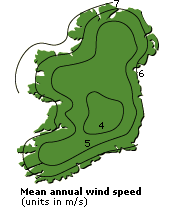
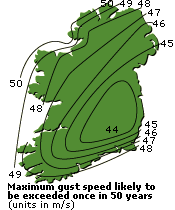
The wind at a item location can be influenced by a number of factors such every bit obstruction by buildings or trees, the nature of the terrain and deflection by nearby mountains or hills. For example, the rather low frequency of southerly winds at Dublin Drome is due to the sheltering consequence of the mountains to the southward. The prevailing air current direction is between south and w. Boilerplate annual wind speeds range from 3m/s in parts of south Leinster to over 8 yard/s in the extreme north. On average there are less than 2 days with gales each twelvemonth at some inland places like Carlow, just more than 50 a year at northern littoral locations such every bit Malin Head.
Beaufort Scale
Diurnal Variation of Wind Speed
During the course of a typical day, the range (difference between the highest and everyman) of mean hourly air current speed is considerable. At Belmullet, a western coastal station, the mean diurnal range is 11.five m/s in January and is still as high as viii.iv m/south in July. At Clones, a typical inland station the mean diurnal range is 8.four m/s in January and 6.two m/s in July. The diurnal variation is much more pronounced in summer than in winter. This is a upshot of surface heating, which increases mixing of the faster-moving air at higher levels with the air near the surface. Equally the issue of surface heating diminishes, the wind speed decreases and during the nighttime at that place is picayune variation from 60 minutes to hour. The diurnal variation is greatest on sunny days and least on dull days. The trend for maximum current of air speed to occur in the afternoon is noticeable simply in the long-term figures and on individual days the maximum may exist at any hour.
Wind Direction
Wind blows almost frequently from the south and west for open sites while winds from the northeast or north occur least often. In Jan the southerly and due south-easterly winds are more prominent than in July, which has a high frequency of westerly winds. Easterly winds occur most often between February and May and are commonly accompanied past dry weather condition. The influence of topography can be seen in the low frequency of winds from a south easterly direction at Valentia Observatory, and winds from a southerly direction at Dublin Aerodrome.
Click station to view data.
Measurements
Wind is the movement of air caused by pressure differences at the globe's surface, which in turn are acquired past the differential heating of the world's surface by the lord's day. Winds play a primal role in the global ship of estrus and energy. The wind regime at the surface is influenced past local topography. Wind measuring sites need to exist open, level and free from obstructions due to buildings and copse etc., for this reason wind speed and direction are measured generally at 10m above basis level.
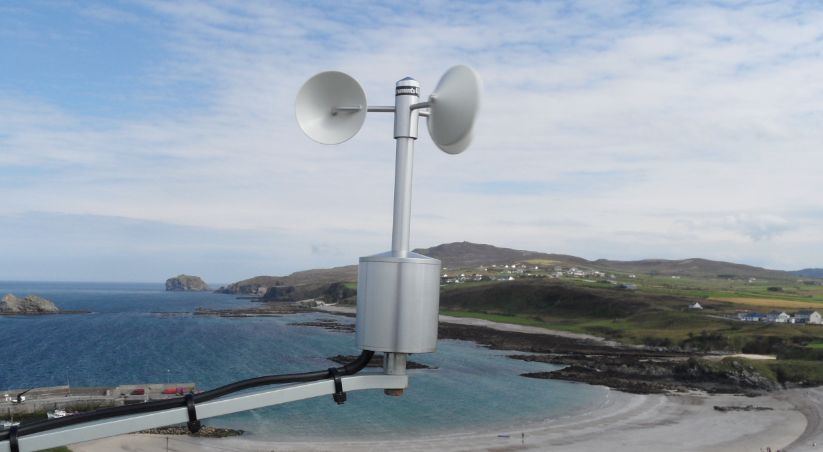
Wind has been measured in Republic of ireland since the tardily 19th century. Wind speed and direction are measured at synoptic weather stations. Upward until the 1990s, current of air speed and direction were measured by Dines force per unit area tube anemometers, these operate on the basis of the force per unit area caused past the air current blowing into an opening on the wind facing end of a current of air vane, since the early on 1990s these have been replaced by loving cup and vane anemometers, with current of air speed measured by rotating cups, and direction by a carve up wind vane.
The current of air at a particular location can be influenced past a number of factors such every bit obstacle by buildings or trees, the nature of the terrain (roughness) and deflection by nearby mountains or hills. Inhomogenieties arise in wind data time series due to changes in instrumentation and changes in station exposure due to new buildings, tree growth etc. in the vicinity of the station. Data used in this department have not been homogenised or corrected for roughness.
Wind speed and direction are continuously recorded and tabulated, either manually or automatically depending on the station location and type. Gust speeds are also recorded, as are the times of highest daily gusts and the hateful wind speed and direction at the time of the highest gust and the highest 10 minute mean speed in a 24 hour period.
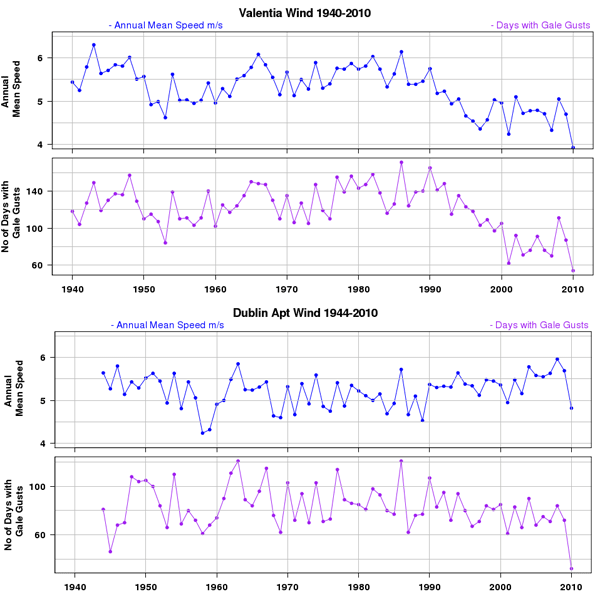
Fourth dimension Series and Trends: Mean annual air current speeds and the number of days per year with gale gusts (a gust of greater than 17.5 m/due south or 34kt) are shown below for Valentia and Dublin Drome.
Source: https://www.met.ie/climate/what-we-measure/wind
0 Response to "Corbett Will the Wind Blow West Again"
Post a Comment